
Categorías
- Ficta Composers
- Josep Alarcón
- Ramon Andreu
- Xavier Casademont
- Josep Cercós
- Francesc Civil
- Andreu Diport i Feliu
- Johan Duijck
- Marcos Fernández-Barrero
- Feliu Gasull
- Enric Granados
- Vicente Goicoechea
- Joan Magrané
- Miquel Oliu i Nieto
- Josep Ollé i Sabaté
- Carles Prat
- Pol Requesens
- Joaquim Serra
- Soler, Josep
- Josep Vila i Casañas
- Mariona Vila
- Àngel Pérez Ortega
- Jaume Aiats Abeià
- Pere Riquet
- Performers
- Events
- Blog
- About us
- Contact
Categorías

Romaní, Raimon
Raimon Romaní (Barcelona, 1974) is composer, conductor and music teacher.
He holds a degree in Composition, as well as a degree in Orchestra Conducting. He teaches harmony, musical analysis, instrumental ensembles, choral singing and french horn at Victòria dels Àngels Municipal School of Music and Conservatory in Sant Cugat del Vallès.
He has been conducting choirs since 1994. He took his first steeps in choral conducting under the guidance of Manuel Cabero and he furthered his training and knowledge following the courses organized by the FCEC and Europa Cantat. Currently he is the conductor of the Choir of the Conservatory of Sant Cugat, the Coral Juvenil of EMMVÀ, the Coral Nova Ègara and the Cor Jove Fusió.
As a composer, the following choral pieces are worth highlighting: La llegenda de Sant Jordi, Magnificat; as well as Cançons de Ciutat, the hymn Veni, creator spiritus the Christmas cantata Pastors a Betlem and the sacred cantata Vacuum monumentum (The Resurrection).
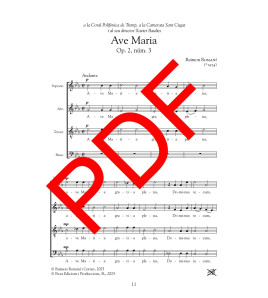
Ave Maria - Cor (SATB) - Digital
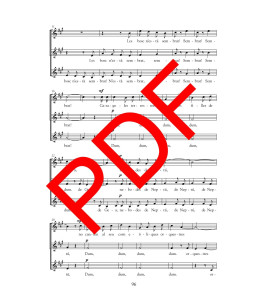
Ave Maria is a motet intended to express love and contemplation. The “Sancta Maria” part attracts particular attention, with its repetitive character encouraging a meditative state. The unison with the word “nunc” underscores the concept of “now”.
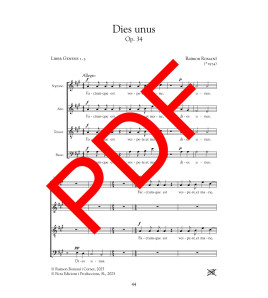
In Stock2,00 € In StockDies unus - Cor (SATB) - Digital
Dies unus, literally “day one”, draws on text from the Book of Genesis: the beginning of the world. By extension, it refers to the initial moment of any life or story, when nothing has happened yet and anything is possible: the moment of great hope.
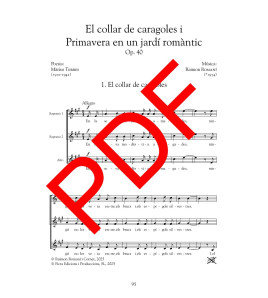
In Stock3,00 € In StockEl collar de caragoles i Primavera en un jardí romàntic (SSA) - Digital
El collar de caragoles i Primavera en un jardí romàntic (The Snail Necklace and Spring in a Romantic Garden) consists of a pair of twinned poems. Their fresh, tender, innocent air expresses sentiments greatly admired by the poet Màrius Torres.
In Stock3,50 € In StockNew Catalan Voices vol.4 - Raimon Romaní
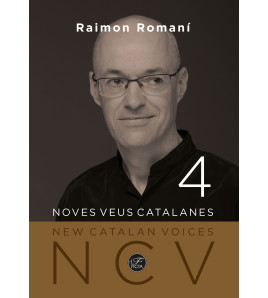
Noves Veus Catalanes - New Catalan Voices vol.4 Anthology of the a choral production by Raimon Romaní.
In Stock20,00 € In StockPobresa - Cor (SATB) - Digital
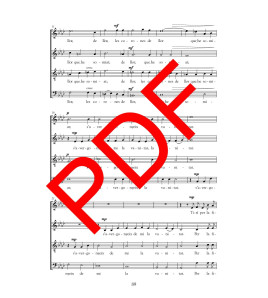
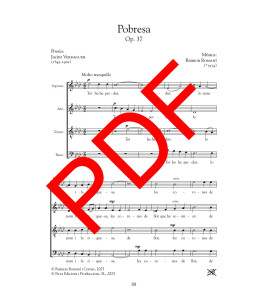
Pobresa (Poverty), with lyrics by Jacint Verdaguer (from the book Flors del calvari), expresses the emptiness we feel when faced with the loss of the things in which we placed our trust, very much a hymn to sadness and the final dignity of people.
In Stock3,00 € In StockReple nos mane - Cor (SSAA) - Digital
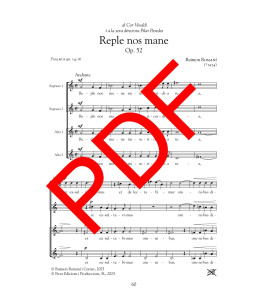
Reple nos mane (“May your love fill us every morning”) is an appeal for love and protection in a moment of uncertainty.
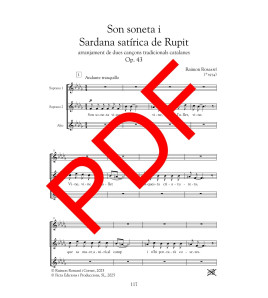
In Stock3,50 € In StockSon soneta i Sardana satírica de Rupit - Cor (SSA) - Digital
Son soneta i Sardana satírica de Rupít (Sleep, Little Sleep and Satirical Sardana from Rupít) is an arrangement of two traditional songs with a considerable contrast. One is a simple lullaby and the other is an ironic, festive song.
In Stock3,00 € In Stock
- 1
- 2
© 2016. Ficta.cat
Online store developed by Botigues.cat
- Google Plus
In collaboration with: